Sponsors help make conferences possible, but sponsor recognition can easily become disconnected from the attendee experience.
Logos may appear on printed signs, slides, websites and programs, yet many of those placements are visible only at specific moments.
Digital displays give conference organizers another way to integrate sponsor recognition throughout the event while continuing to provide useful information to attendees.
The objective isn't simply to put more logos on screens. It's to create valuable sponsor visibility without compromising the usefulness of the event's digital signage.
Start With the Sponsorship Experience
Before designing sponsor graphics, consider where sponsorship fits into the attendee journey.
A typical conference might include:
Arrival → Registration → General Sessions → Breakouts → Exhibits → Networking → Departure
Each stage presents different opportunities.
A sponsor message at registration serves a different purpose than sponsor recognition outside a ballroom or inside an exhibit area.
Start by asking:
Where will attendees naturally spend time?
Which locations provide meaningful visibility?
Where can sponsor content complement rather than interrupt the attendee experience?
Those answers should drive the display strategy.
Identify High-Value Sponsor Locations
Not every display has equal sponsorship value.
Locations with substantial attendee traffic or dwell time may provide greater visibility.
Potential locations include:
- Registration and check-in areas
- Main conference entrances
- Ballroom foyers
- General-session entrances
- Breakout-room corridors
- Exhibit-hall entrances
- Networking areas
- Charging or lounge areas
- Meal-function entrances
The value of each location depends on how attendees actually move through the event.
A display in a quiet corridor may generate fewer meaningful impressions than one positioned near registration or a major session entrance.
Combine Sponsor Recognition With Useful Information
A digital display doesn't necessarily need to choose between event information and sponsorship.
For example, a registration display might rotate among:
Welcome to the Conference
Today's Opening Session
Registration Information
Thank You to Our Presenting Sponsor
Similarly, a ballroom display might combine:
Current Session
Speaker Information
Next Session
Session Sponsor
This approach integrates sponsor recognition into the event communication system rather than treating sponsorship as a separate layer.
Use Content Rotation Carefully
One advantage of digital signage is the ability to rotate multiple messages through the same display.
That can create more sponsor inventory without requiring additional physical signs.
However, excessive rotation creates another problem:
A sponsor placement has little value if attendees rarely see it.
Consider:
Number of messages in the rotation
Length of each message
Expected attendee dwell time
Importance of the sponsor
Location of the display
For example, a display near registration may have longer attendee dwell times than a screen positioned along a fast-moving corridor.
The content rotation should reflect that difference.
Match Recognition to Sponsorship Level
If your event has multiple sponsorship tiers, digital signage can help differentiate the value of each package.
A presenting sponsor might receive prominent placement on high-traffic displays.
Other sponsors might appear within rotating recognition sequences.
Session sponsors could appear on displays associated with their sponsored sessions.
Exhibit sponsors might receive recognition near the exhibit area.
The specific structure will vary by event, but the principle is straightforward:
Higher-value sponsorship packages should receive clearly differentiated visibility.
Digital signage gives organizers more flexibility in designing those distinctions.
Think in Terms of Sponsor Inventory
Conference organizers often think of sponsorship inventory as physical assets:
Printed signs
Lanyards
Badges
Programs
Tables
Banners
Session sponsorships
Digital displays introduce another category of inventory.
A single display location can potentially support several sponsor opportunities across different periods of the event.
For example:
Morning → Breakfast sponsor
Midday → General sponsor rotation
Afternoon → Session sponsor
Evening → Reception sponsor
This means digital signage can become part of the sponsorship strategy rather than merely an event operations expense.
Don't Overload Wayfinding Displays
Some displays have a critical operational purpose.
A screen directing attendees toward breakout rooms should remain easy to understand.
Sponsor content shouldn't obscure arrows, room names, schedules or other essential information.
A good rule is:
The primary purpose of the display should remain immediately obvious.
If the screen exists primarily for wayfinding, sponsor recognition should support that purpose rather than compete with it.
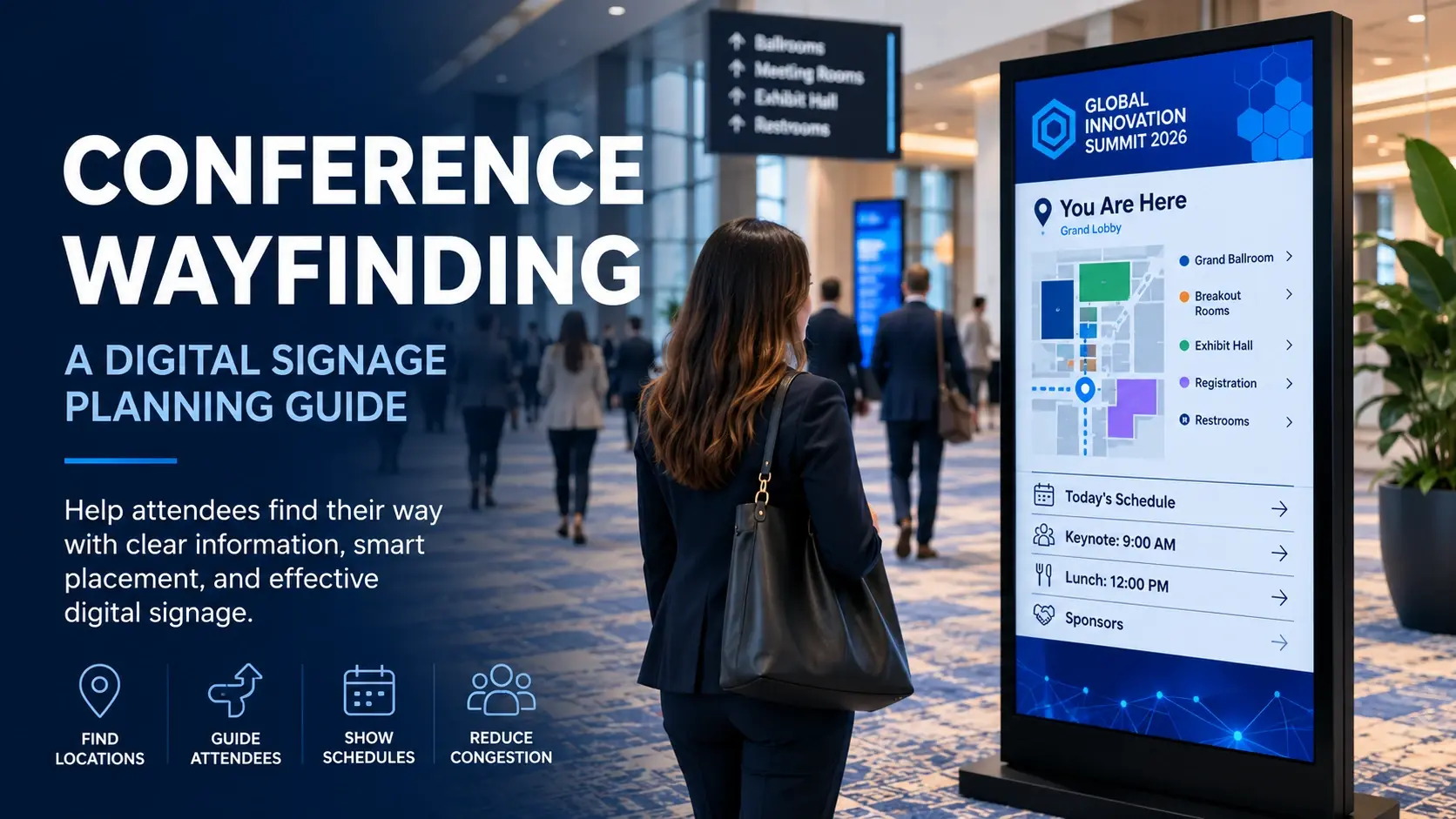
For more on planning these locations, see our Conference Wayfinding: A Digital Signage Planning Guide.
Design Sponsor Content for the Screen
Sponsor assets designed for websites, printed programs or presentation slides may not automatically work well on floorstanding displays.
Consider:
Orientation. Is the display portrait or landscape?
Viewing distance. How far away will attendees typically be?
Logo size. Can the sponsor identity be recognized quickly?
Contrast. Is the content readable under venue lighting?
Duration. Can attendees understand the message before it rotates?
Motion. Does animation improve the message or simply create distraction?
Designing content specifically for the intended display generally produces better results than simply resizing an existing graphic.
Plan Content Deadlines for Sponsors
Sponsor content can become an event-production bottleneck if assets arrive late or in inconsistent formats.
Establish requirements before the event.
Sponsors may need guidance regarding:
Image dimensions
Orientation
File format
Video specifications
Logo requirements
Submission deadlines
Approval process
The earlier these requirements are communicated, the easier it becomes to prepare and test the final display content.
Consider Sponsor Recognition Throughout the Day
The value of a display location can change as attendees move through the event.
Registration may be extremely valuable in the morning but receive relatively little traffic later.
Ballroom foyers may become more valuable immediately before and after general sessions.
Networking areas may become important toward the end of the day.
Digital signage makes it possible to adapt sponsor recognition to these changes.
Instead of showing identical sponsor content everywhere for the entire event, organizers can plan messaging around time, location and attendee behavior.
Connect Sponsorship With the Overall Display Plan
Sponsor recognition should be considered when determining how many displays the event requires.
If a display is already needed for schedules or wayfinding, it may also provide appropriate sponsor inventory.
In other situations, organizers may decide that a dedicated sponsor-recognition location provides enough value to justify another display.
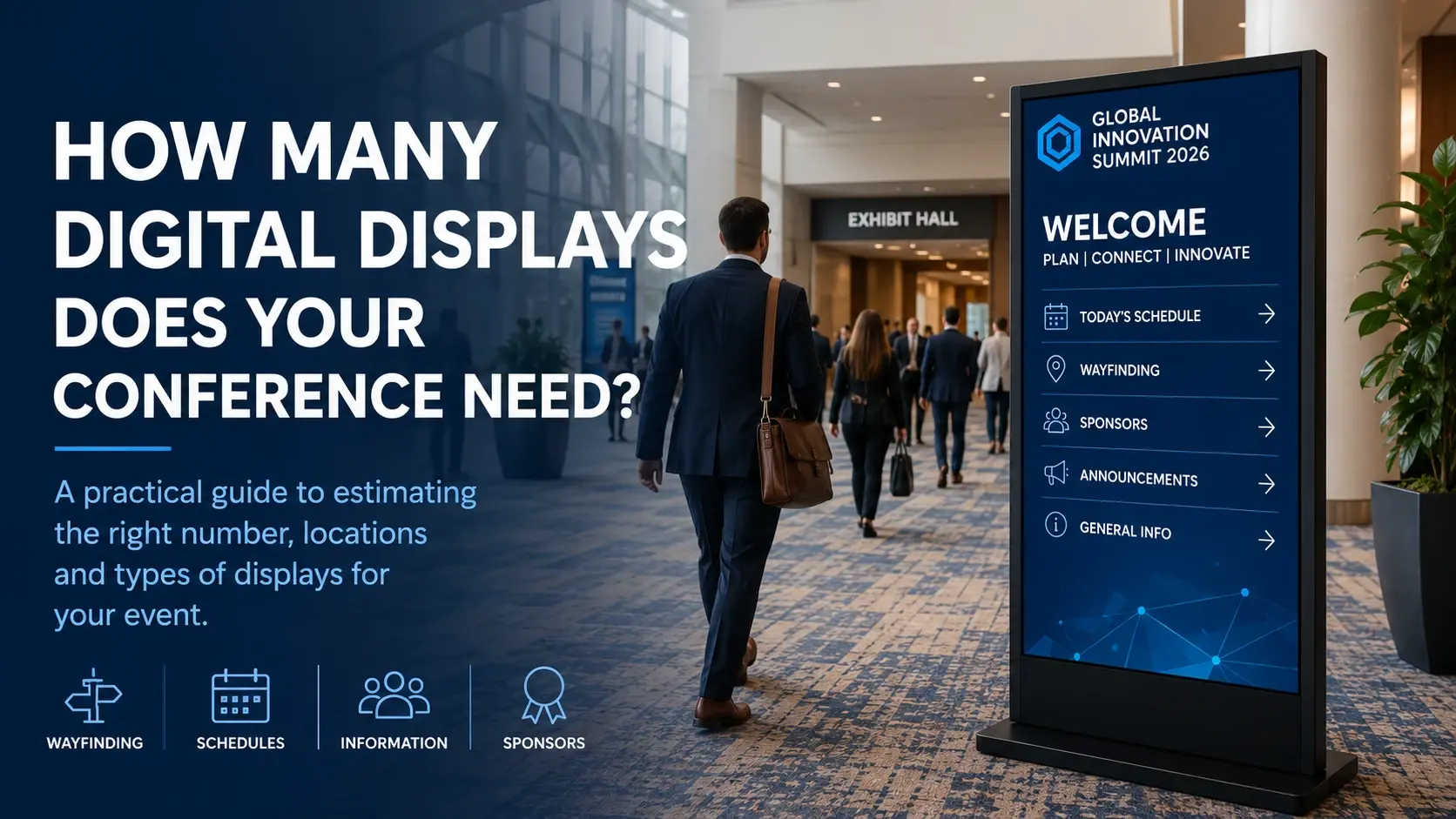
Our guide How Many Digital Displays Does Your Conference Need? explains how venue layout, attendee flow and display purpose can be used to estimate requirements.
Measure What You Can Deliver
If digital recognition becomes part of a paid sponsorship package, organizers should be clear about what they're promising.
Document:
Which displays include sponsor content
Where those displays are located
How often sponsor content appears
How long the placement runs
Whether the sponsor has exclusive or shared placement
Even when precise impression measurement isn't available, clearly defined deliverables make the sponsorship package easier to explain and fulfill.
Over time, event teams can also use attendee traffic, display locations and sponsor feedback to improve future packages.
Start With the Conference Signage Strategy
Sponsor recognition works best when it is designed as part of the broader conference communication plan.
Displays may need to support:
Welcome messaging
Schedules
Wayfinding
Session information
Announcements
Sponsor recognition
Our Conference Digital Signage Planning Guide provides a broader framework for deciding how those functions work together.
Planning Sponsor Displays for an Orlando Conference?
Orlando conferences frequently take place in large hotels, resorts and convention environments where attendees move through multiple high-traffic areas during the event.
Those environments can create valuable opportunities for sponsor recognition at registration areas, ballroom foyers, exhibit entrances and other attendee touchpoints.
iMediaSign provides professional digital displays, touchscreens and event technology for conferences, meetings, trade shows and corporate events throughout Orlando and Central Florida.
If you're planning the overall technology experience, explore our Conference & Meeting Technology solutions.
If you already know you need displays for an upcoming conference, explore Event Display Rentals.